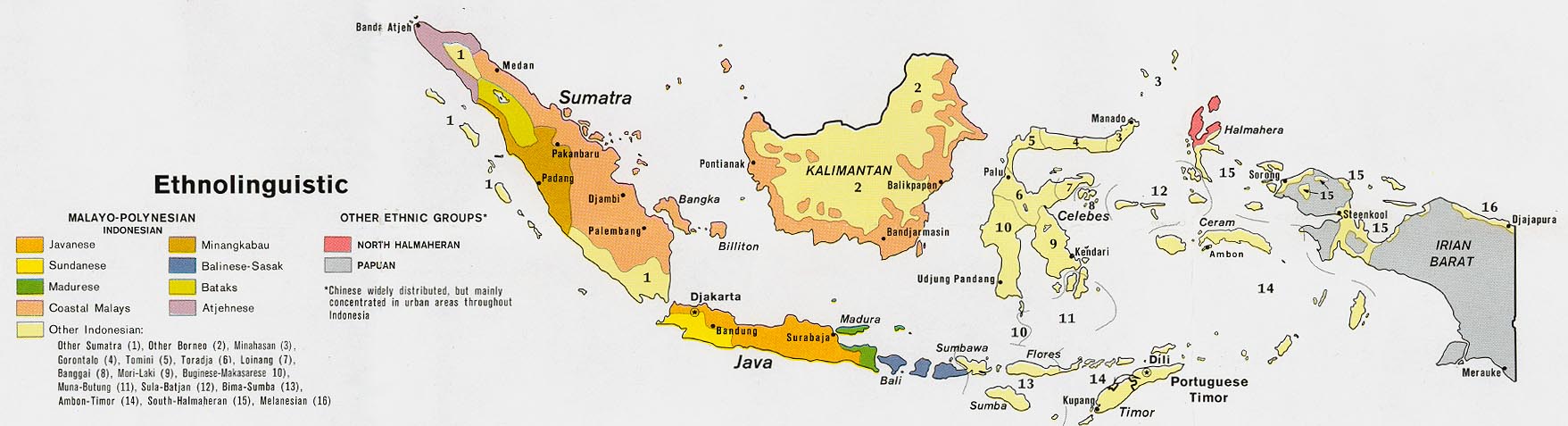
The Leti people live on Leti Island, the westernmost of the Leti Islands in Southwest Maluku province, Indonesia. Their native tongue is Leti, an Austronesian language, which belongs to the Timoric subgroup and is closely related to other languages in the Luangic–Kisaric branch. Few Leti speakers are literate in Leti itself; many are literate in other languages such as Indonesian.
Historically, Leti society has preserved its own oral traditions, including a chronicle known as the Hikayat Leti (The Leti Chronicles), which links the people's sense of identity to the domains of Luhuleli, Laitutun, Tomra, Tutukei, Batumiau, Nuwewang, and other areas.
Carved wooden figures called yene have long played a role in Leti culture; these represent ancestral spirits or cosmological figures, and they testify to a deep-rooted belief system.
Life among the Leti people centers on close-knit village communities scattered across Leti Island. People earn their living principally through subsistence farming, raising crops suited to the island's terrain and climate, and by fishing in the surrounding seas. Their daily routines are shaped by the rhythms of nature, and their cultural traditions remain strong. The yene statues are often kept in the attic of traditional homes, reflecting a continuous relationship between the living and their ancestors. Social status and identity may also be reflected in these statues: some yene are ornamented with headgear or jewelry that indicate rank, caste, or ancestral prestige.
Although they are relatively remote, the Leti have had contact with outside influences over time. Their interactions with neighboring island groups have introduced change, but much of the older social structure remains in place.
In the present day, a majority of Leti people identify as Christian. However, many still blend traditional beliefs with Christian faith, and there is strong cultural memory of ancestral and spirit-centered practices.
According to available information, the Leti worldview historically embraced a folk religion centered on cosmological deities, ancestral spirits, and the land itself.
They believe in a male god associated with the sun and a female god associated with the earth. The carved ancestor statues (yene) are understood to act as temporary vessels for departed spirits; after death, a person's "shadow" lingers in the village for a time before journeying to a distant island in the spirit world.
The Leti offer items such as betel nut, lime, and at times palm wine to these statues as part of rituals tied to fertility, ancestral honor, and community well?being.
The Leti people face a number of urgent needs. Their language is endangered, and there is little formal education in Leti, threatening the transmission of traditional knowledge and identity. Many do not yet have full access to scripture, audio?Bible, or New Testament resources in their heart language.
Health services and infrastructure are limited on their remote island, and livelihood opportunities remain constrained by their reliance on traditional agriculture and fishing.
At the same time, despite the presence of Christianity among them, there is a deep need for discipleship that goes beyond nominal faith: many Leti believers have little access to continuous biblical teaching, leadership development, or a robust, multiplying church movement.
Pray that God would grant wisdom and provision to Christian workers to help produce scripture resources, audio Bibles, and discipleship materials in the Leti language.
Pray for spiritual awakening among Leti believers, that the Holy Spirit would bring renewal, deepen their faith, and raise up strong, mature disciples who can become disciple-makers.
Pray for church planting teams to come and serve among the Leti with humility and love, integrating physical care (health, education, economic development) with proclamation of the gospel.
Pray for protection, provision, and improved infrastructure for Leti villages, that their basic physical needs would be met, and they would know the love of Christ in tangible ways.
Pray for the Leti community to release traditional practices that conflict with biblical teaching, and for them to fully place their hope in Jesus as Savior and Lord rather than in ancestral spirits.
Pray for unity and peace among Leti believers and communities, that through reconciliation and fellowship they would grow into a strong, vibrant church.
Scripture Prayers for the Leti in Indonesia.
Ethnologue, Leti (lti) language.
Folklore Fellows' Network: Hikayat Leti and other Leti traditions.
Yene ancestor spirit dolls and Leti cosmology (Wikipedia summary).
Estimated demographics and religious context in Maluku province.
| Profile Source: Joshua Project |